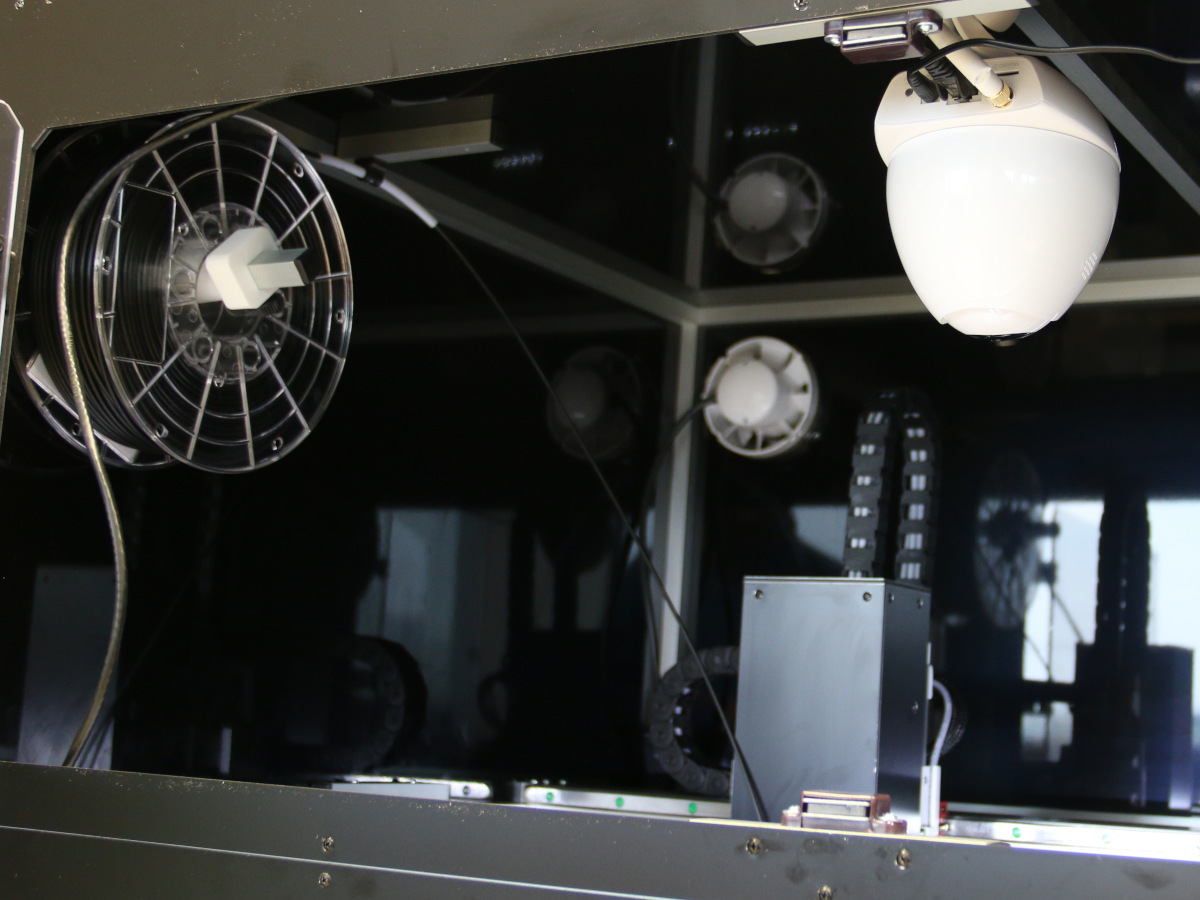
Professional large-format 3D printing has become an increasingly important tool for companies, technical offices, engineering departments, and research centers. The ability to create large components , functional prototypes, models, molds, and equipment directly from a digital file significantly expands the possibilities of additive manufacturing.
However, choosing a professional large-format 3D printer isn’t just about finding the machine with the largest print volume. To achieve good results, you need to analyze various technical features, from compatible materials to precision, speed, stability, and actual production needs.
Making the right choice allows you to make the most of your investment and tailor additive manufacturing technology to your company’s specific goals.
What is a large-format professional 3D printer?
A large-format 3D printer is an additive manufacturing system designed to produce objects larger than those achievable with small-format equipment.
The process involves progressively creating a component using different layers of material. It starts with a three-dimensional digital model , which is processed by software to convert it into the necessary manufacturing instructions.
In the professional field, these systems are designed to operate for extended periods and to meet the needs related to industrial prototyping, tooling production, model making and the production of custom components .
The size of the machine is important, but it is not the only criterion to take into consideration.
Why choose a large-format 3D printer?
The main advantage is the ability to produce components that would not be compatible with a conventional 3D printer.
This allows for the production of full-scale prototypes , large components, oversized molds, and custom structures. In some cases, it’s even possible to produce a complete part without having to break it down into multiple components.
Reducing the number of components can simplify subsequent assembly operations . Furthermore, manufacturing directly from a digital model facilitates modifications during the development phases.
For a company that constantly works with different prototypes, this flexibility can be particularly attractive.
Print volume as the main selection criterion
One of the first parameters to analyze when choosing a large professional 3D printer is the maximum production volume.
It is important to distinguish between the maximum dimensions advertised by the manufacturer and the actual space needed for typical projects.
An excessively large machine may be a waste of money if most of the components produced are much smaller. Conversely, an insufficient volume may force you to split the objects, increasing subsequent assembly operations.
For this reason, it is advisable to analyze the dimensions of the pieces that will be produced most frequently and select a working volume that offers sufficient margin.
Compatible materials
Another key factor is the 3D printing materials that are compatible with the equipment.
The different materials have distinct characteristics in terms of mechanical strength, flexibility, thermal stability, ease of printing and durability.
Materials used in additive manufacturing include various types of polymers, as well as engineering materials and reinforced composites.
The choice will depend directly on the application. A visual prototype may require different features than a functional component designed to withstand mechanical stress.
Therefore, before purchasing a large-format professional 3D printer, it is important to check which materials it can work with , under what conditions and with what parameters.
Professional large-format 3D printer: how to choose the right model
To correctly choose a professional large-format 3D printer , it is advisable to compare various technical and manufacturing aspects. The main criteria include:
- Print volume: must be sufficient to produce the desired parts without having to continuously resort to divisions.
- Compatible materials: It is essential to check that the machine is compatible with the materials required for professional applications.
- Manufacturing accuracy: particularly important when components must meet certain dimensional tolerances.
- Printing speed: a key factor in reducing production times and increasing productivity.
- Process stability: a professional machine must guarantee consistent results even during prolonged operation.
- Extrusion system: must be adapted to the type of material and the volume of material to be deposited.
- Ease of use: An intuitive interface can simplify job preparation and tracking.
- Maintenance: It is advisable to evaluate the ease of performing cleaning, replacement and periodic maintenance operations.
- Software: Model preparation tools can significantly influence final quality.
- Technical support: For companies that rely heavily on technology, having specialized support can be essential.
- Material consumption: must be analyzed in relation to the volume and type of pieces to be produced.
- Growth potential: A flexible solution better adapts to future production needs.
Precision and quality of components
Accuracy is especially important when the printer is used to produce functional components.
Maintaining consistent dimensions throughout the entire printing process for a large object can be more challenging than for smaller objects. Factors such as temperature, structural stability, adhesion, and printing parameters can influence the final result.
Therefore, a professional 3D printer must offer good mechanical and thermal stability.
Layer resolution is also an important factor to consider. A lower layer height can improve some surface detail, although it typically increases production time.
The configuration must always be adapted to the project objective, seeking a balance between quality, speed and productivity .
Print speed and productivity
In a professional context, the time required to produce a component can have a direct impact on the profitability of the process.
When producing large objects, print runs can last many hours. For this reason, production speed must be analyzed in conjunction with extrusion volume, precision, and stability.
An extremely fast printer is not necessarily the best solution if the resulting print quality does not meet the needs of the project.
The most suitable solution will be the one that is able to maintain a good balance between productivity and production quality .
Industrial prototyping
One of the most common applications of large-format professional 3D printers is industrial prototyping .
Design and engineering departments can quickly create physical models to test a product’s features before starting final production.
The ability to make changes to the digital file allows for the creation of different versions of the same prototype.
This rapid, iterative process can help identify design errors, assembly issues, or dimensional concerns before investing in more complex tooling and manufacturing processes.
Production of molds and equipment
Large-format 3D printers can also be used to produce custom molds, models, and tools .
In some industries, companies require specific tools to perform certain tasks. Producing them using traditional methods can take longer and involve several manufacturing steps.
Additive manufacturing allows you to create these solutions directly from a digital design.
This can be especially useful when small runs or custom tools are needed , as it allows you to quickly modify the design as needs change.
Applications in various industrial sectors
Large-format 3D printing technology can be used in numerous industries.
In the automotive industry , it can be used for prototypes, components, models and tooling.
In engineering , it allows the development of custom parts, supports, models and various elements intended for industrial processes.
In architecture , it facilitates the creation of large-scale models and prototypes.
In industrial design , it allows you to quickly transform a digital concept into a physical model.
It can also be used in fields related to research, machinery manufacturing, technical training and product development.
The importance of software
A 3D printer’s performance depends on more than just its physical components. Configuration and control software also plays a crucial role.
Before starting production, it is necessary to convert the 3D model into instructions that the machine can interpret.
The software allows you to configure parameters such as layer height, speed, infill, supports, temperatures and print paths .
Proper setup can help improve component quality and reduce material consumption.
For professional users, having sufficiently comprehensive control tools can make managing complex projects easier.
Ease of maintenance
A 3D printer used professionally must be kept in good condition to ensure consistent results.
Before choosing a computer, it is advisable to evaluate the ease of access to components that require regular maintenance.
It is also important to check the availability of spare parts, technical documentation and specialized assistance .
Proper maintenance can help reduce downtime and extend the life of your machine.
3DPRN and professional large format solutions
In the field of professional additive manufacturing, 3DPRN offers solutions designed for companies that need to use 3D printing in industrial and large-format applications.
When evaluating a solution of this type, it is important to analyze the specific needs of each project and not limit yourself to comparing only the price or maximum dimensions.
A professional large-format 3D printer should be considered an integral part of a production process. Therefore, aspects such as materials, productivity, precision, ease of use, and stability are of fundamental importance.
Is it better to buy a large 3D printer or rely on an external service?
For some businesses, purchasing a professional 3D printer might be the best option. For others, it might be more cost-effective to initially outsource production.
The decision depends on factors such as production volume, frequency of use, complexity of components and the need for in-house production .
When a company is constantly producing prototypes or needs to quickly manufacture custom components, having its own team can offer greater autonomy.
On the other hand, if the needs are occasional, outsourcing certain activities can represent an interesting alternative.
Mistakes to avoid when choosing a professional 3D printer
One of the most common mistakes is to choose a machine based exclusively on its print volume .
Ignoring compatible materials or failing to analyze actual accuracy requirements can be a problem.
Another aspect not to be underestimated is maintenance. A professional machine must be properly maintained to ensure stable operation.
Finally, it’s important to consider future needs. The printer you choose should offer enough flexibility to adapt, where possible, to new projects and materials.
Choosing a professional large-format 3D printer requires analyzing several technical and manufacturing factors. Print volume is important, but it must be evaluated alongside accuracy , compatible materials, speed, stability, software, and ease of maintenance .
Large-format additive manufacturing offers numerous opportunities for companies that need to produce prototypes, molds, tooling, models and components on a large scale .
A well-considered choice allows you to make the most of the technology’s potential and transform 3D printing into a useful tool for improving design, development, and production processes.
In a market increasingly oriented towards digitalization, customization and flexible production , investing in a professional large-format solution can represent an opportunity to increase production autonomy and respond more quickly to the needs of the sector.


